Delhi
Travelling in Delhi isn’t just limited to history but it’s a step to take past and present hand in hand. Blended with modern advancements, Delhi is the modern-day city of Troy. The amalgamation of all religion and spiritual hubs of different faiths coexisting together in peace is the testament of the unity in diversity. Delhi offers numerous tourist attractions ranging from monuments, museums, shrines to modern day markets. Exploring the city is like witnessing a mini-India, with Delhi Tourism being a reflection of rich culture of India.
Historically Monuments in Delhi
Humayun's Tomb
A UNESCO World Heritage Site, Humayun’s Tomb is a stunning piece of Persian architecture built in the Mughal era. It was commissioned in 1526, nine years after Humayun’s death, by his widow Hamida Banu Begum. This beautiful monument is made of red sandstone.
The tomb is in the centre of Charbagh-style of gardens with pools that are connected to canals. It has two entrances: a southern side and a western side. The high central arch and the octagonal shape of the structure are important aesthetics of Mughal architectures
Kutub Minar
This 73-meter high tower was built by Qutub-ud-Din Aibak in the year 1193. Built after the defeat of Delhi’s last Hindu ruler, the Qutub Minar was constructed to celebrate the Muslim supremacy in Delhi. It is the highest tower in India, with five levels and projecting balconies. The first three levels are made up of red sandstone and the last two of marble and sandstone.
The Qutub Minar has three different types of architectural styles. The construction of the minar was started by Aibak (who only made the basement). Later, Iltutmish added on three stories and then it was completed by Firoz Shah Tuglak, who constructed the last two stories. Quwwat-us-Islam Mosque, the first mosque ever to be built in India, is situated here.
Red Fort
This enormous red sandstone fort is synonymous with Delhi and is testimony of the glory of the Mughal Empire. Built in 1638 by Shah Jahan, it took around ten years to be completed.
A UNESCO World Heritage Site, the Red Fort is octagonal in shape with walls adorned with flowers and calligraphy, typically in the style of beautiful Mughal era architecture.
Jama Masjid
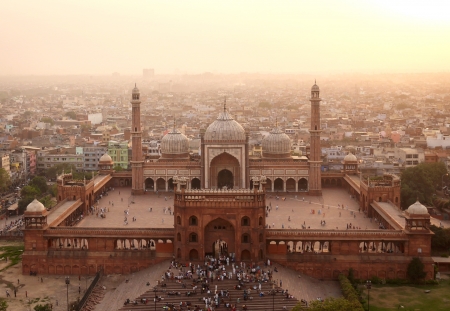
The Jama Masjid is India’s largest mosque. With minarets on all four sides that reach the skies, Jama Masjid, Emperor Shah Jahan’s last architectural indulgence, was commissioned in 1650 and took six years to be built. The enormous courtyard of the Jama Masjid can hold around twenty-five thousand worshippers.
India Gate
Situated in the heart of the city, India Gate is one of the most popular and well known monuments in India. It was designed by Edwin Lutyens. With lush green and well-manicured lawns around, the foundation of this historical structure was laid in 1920.
It was unveiled in 1933 and dedicated to all the Indian soldiers of the British Army that were killed in World War 1 .




_1581407722.jpg)